Monday, May 25, 2009

Gedenkstätte

So after that brief Spanish hiatus/siesta (?) I want to try and catch up to where I left off back in April. It’s weird, I know, to be jumping around like this but I really want to record it and show off pictures and such. Plus, there are some fun stories coming up.

Anyway, last thing I wrote about in April was the Tuesday of the week that Brad came to visit. On Wednesday, April 24th, I decided to take Brad to the concentration camp in Dachau. I had waited for spring, better weather, and company to better temper what I imagined the experience would be like. To be honest, I really had no idea what to expect and still have trouble knowing exactly how to react to something so poignant and yet distant and foreign, to the point of being inaccessible. I was never overwhelmed during my visit, quieted and disgusted yes, but my reaction was primarily contained in intellect, in a neutral and callous response to very comprehensive memorial to the victims of such immense and apparent atrocity. It’s so hard for me to fully convey because it’s so hard for me to understand or relate. Hmmm.

Dachau, the city, was at one time a lively artsy-type town just a little outside a cultural center. That was in the 1800’s. Now it’s one of Munich’s most affordable suburbs. The concentrating happened somewhere in between.

The Dachau Concentration Camp was the first camp established by the Nazi’s for their political and domestic prisoners. It started out as a prison/work camp and was shown to the world as an example of how productive Nazi society could be and how well they treated their prisoners. This, of course, was simply a show, though the conditions would get much worse. Being a camp on German soil Dachau was never an industrial death plant like Auschwitz, Bergen-Belsen, or Treblinka but it was the test sight for many of the horrors put into full force in these camps, including gas chambers and crematoriums. Dachau was also a medical research facility, where the Nazi’s tried to cure malaria by infecting prisoners and trying different medications to see their effects. In addition to the malaria studies they preformed battlefield survival experiments where they would drown or freeze people to death to see how long a downed airman could survive in the open ocean.

We left Munich early on Wednesday and took the train out to Dachau the town. From Dachau the town we went to Dachau the camp. Besides a bus stop and sign by the road, the entrance to the camp was very modest. The camp is open daily with absolutely no entrance fee.

Here’s the outer fence:


When we got inside we split off to wander on our own. I would recommend tackling something like a concentration camp in this manner as it leaves you free to contemplate things, take things at your own pace, and linger where you personally ought to linger. I’m glad I got the chance to do it that way.

Right inside the wall you see the museum and former processing center for prisoners:


The museum was really good and really detailed, covering not just the history of the camp and the various despicable going-ons therein but also the rise of Nazism in Germany and the climate that allowed it to flourish. I didn’t have enough time to do it justice, but I’d like to go back.

Behind it was the a prison within a prison for those people that acted up or were particularly hated by the Nazi’s. Here:


When the Americans used the camp to hold war criminals after the war, they put windows into the walls of this building to make it a tad more humane; beforehand each room was solitary and pitch-black.


They even had a few standing-only cells, which were cells divided further into 4-6 stalls:


Eerie.

Behind the prison are these poles where, as punishment, prisoners would be hung off the ground by their arms for several hours.


In front of the museum there are a few different pieces of artwork:


Directly in front of that once stood row after row of prisoner barracks, of which two have been rebuilt and the rest are nothing but foundations. Here’s a little panorama:


Inside are reconstructed versions of different rooms and different conditions for the barracks. First, the original bedroom configuration:


Later on in the war, when the Nazi’s ramped up their Final Solution in order to try and actually finish, the camps were forced to hold something like 10 times their normal capacity. The barracks had to too:


After the long rows of barracks stood three different memorial chapels: one Protestant, one Catholic and one Jewish.

This is the Jewish one:


The text translates to: "Send them a warning, oh Eternal One, that they may know that they are mortal!" There's a verse reference at the end there to Psalm 9:21, but I think it's actually Psalm 9:20, since there is no verse 21.


The sign says: "Over 6 Million Jews fell prey to the National-Socialist Regime".

This was in the Protestant one:


It translates to: “Refuge is found in the shadow of your wings."

I apparently didn’t take a picture of the Catholic one. Hmmm.

I do think it would be interesting to go to a service at the Protestant Chapel there one Sunday, just to see what it’s like.

A monastery was built, attached to the camp, directly behind the Catholic chapel:


At the bottom corner of the camp there is a bridge leading to the crematorium. As you cross the bridge you can see the trenches dug in front of the barbed wire to help prevent prisoners from escaping. If anyone were to run into the ditch they were shot immediately. Many people died in these trenches trying to escape the camp, many people just ran into them to die faster.


Before the crematorium area were several memorials:


"Remember how we died here."


"To the dead, honor.
Let the living be a warning to the future."

This is the main crematorium building, where bodies were burned:


Attached to the crematorium is one of the first Nazi gas chambers and only authentic chamber saved after the war. Gas chambers elsewhere were dismantled by the Nazi’s in attempts to hide what they had been doing or simply demolished by American forces after camps take-over. At Dachau the prisoners insisted that the chamber remain, as a testament that would last longer than they could.

The chamber was disguised as a shower:


This is inside:


I ended up sitting in there for a little while, trying to make sense of what I was seeing and trying to know what to feel.


Behind the crematorium was a path that led through a small patch of forest full of ash pits and memorials to the thousands of unknown dead:


Also in these woods was a wall used during firing squad executions:


It's all covered in foliage, as you can see, but at the bottom is a trough that once collected blood.

On the other side of the crematorium from the woods stands a Russian Orthodox chapel:


And that is Dachau.

Overall, I thought the memorial was really well put together and really respectful. It maintains a certain solemnity while catering to a wide range of visitors and tourists, never sinking to exploiting these visitors. The only things you have to pay for are things to help you better understand what happened there, like books or tours. It is otherwise free and open. I also really appreciated the amount of information on signs and such available all over the camp to explain things. Really really good.

---

After Dachau we took the time to unwind and spend time with some of the JYMers. A group of maybe ten or fifteen people decided to hang out in Sam’s room that evening, which was really nice.

This you might enjoy: Blane fell asleep for a bit on Sam’s bed and we had the delightful idea to paint him. He woke up at one point but let us continue. Here he is:


That’s it for Wednesday!

Friday, May 22, 2009

"Bed and Two Bedside Tables Ferociously Attacking an Violoncello"

We had another early bus out of town that morning. This bus was early enough that it made some sense to wake up a little early and try to catch the sunrise over the bay. Unfortunately, it was cloudy. At least we tried.

From Cadaqués we took the bus inland to Figueres, birthplace, childhood home, and, now, site of an entire museum devoted to Salvador Dalí. My flight was at 4:30 that day and we made it to Figueres at 10:30; we had plenty of time.

On the walk from the bus station to the museum, we found the first sign of Dalí:


Brilliant!

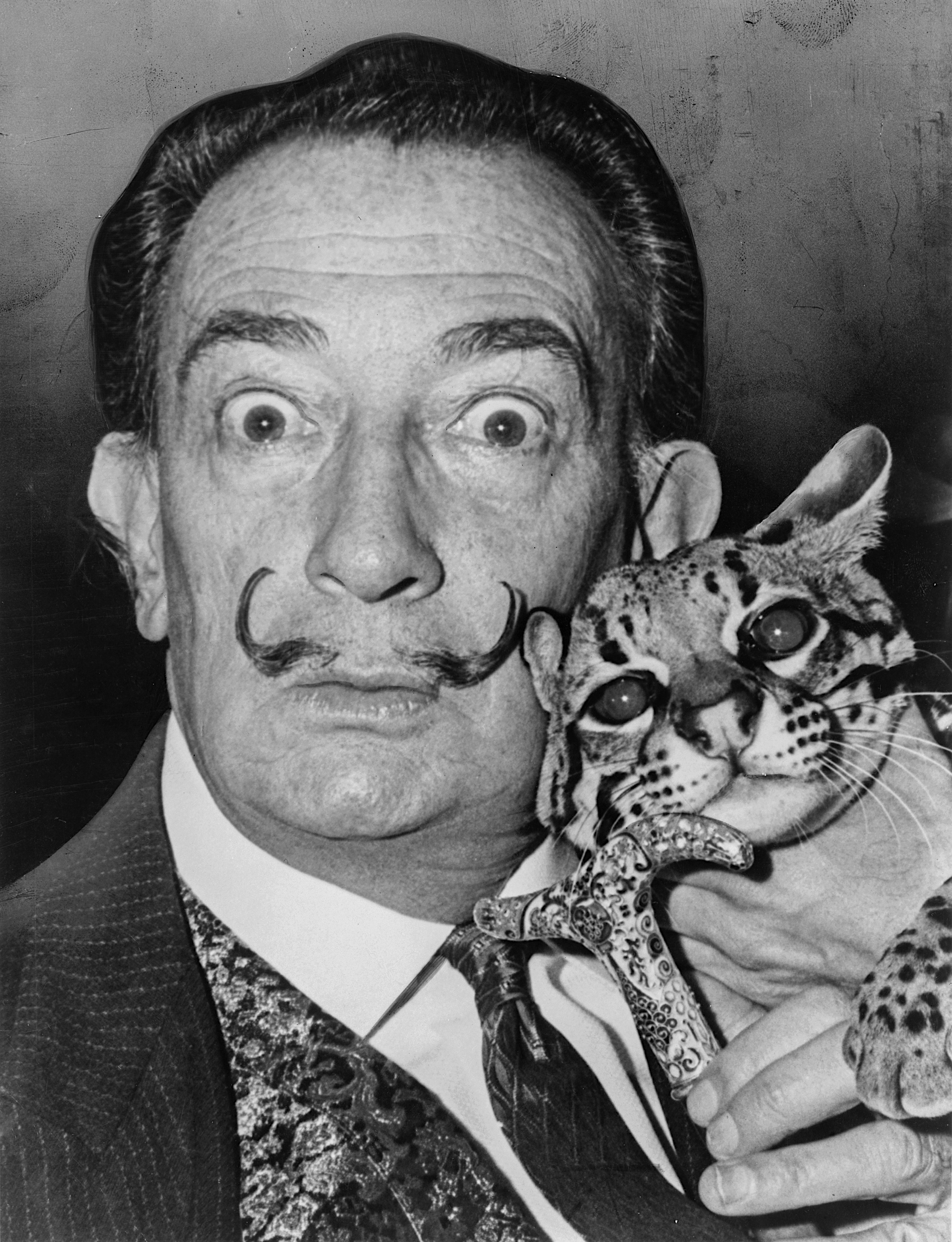
As you read this post and see all the wacky crazy pictures, remember that this is Salvador Dalí:


I am a little bit jealous that he can do that with his mustache.

Anyway, the museum is called the "Teater Museu Dalí" or "The Theater Museum of Dalí". On the museum Dalí said, "Where, if not were in my own city, should the most extravagant and solid examples of my art remain, where else? The Municipal Theater, or what was left of it, seemed to me to be very appropriate for three reasons: first, because I am an eminently theatrical painter: second, because the Theater is in front of the church where I was baptized and third, because it was precisely in the lobby of the Theater that I had my first exhibition of paintings". The building was, in fact, a former theater practically destroyed in the Civil War in the 1930's.
Here it is:


Again, remember that Dalí designed the place himself and oversaw the construction.


The museum was really crowded; it seems to have become a bit of an amusement park almost. Still, it had a lot of crazy stuff and really interesting paintings.


Abe Lincoln?


Maybe not; look closer.


The Poetry of America:


The Mae West Room, an installation modeled after an earlier painting:


(I didn't take this one.)

We were here just the day before:


"Bed and Two Bedside Tables Ferociously Attacking an Violoncello":


Oh my oh my. There was a lot of other stuff there too, like holograms and sculptures, but I always feel weird taking pictures in an art museum.

I was really struck by the a powerful impression of humility in the following reoccurring image, though I'm not sure what to make of it the larger context of the works in teh corridor.


Overall, I was very impressed at the way Dalí had shown mastery of a number of different styles of art. In his later years this turned into some very inventive and very unique creative works, like his holograms or his reflective cylinder things, like in the picture at the top. He was a goof-ball, a genius, a weirdo, and a man with a great mustache; the kind of guy I'd like to read a little more about for, at the very least, a good laugh.

I laughed a lot at this museum.

From the museum we trained to Girona. I grabbed a tortilla sandwich (which had no potatoes!!) and caught a bus back to the airport. Mang-git decided to stay until early Monday morning to catch a cheaper flight back to Munich. I had class early Monday and didn't want to sleep in an airport, so I bit the bullet and took the slightly more expensive flight home.

While walking to the plane during boarding I uttered the word "endlich", which means "finally" in German, which ended up sparking a conversation with the German guy waling next to me. His name was Thomas. I would soon discover that he lives in Rotes Haus in StuStadt and knows Mimi, one of the girls from the program. Small world.

After the flight Thomas drove me back to Munich from the airport, which was really nice of him and a great opportunity for me to try and speak some German. I've gotten to the point where I speak very good "party German", a term I devised for the basic phrases one needs at a party like: "I'm from Cleveland", "I study engineering", "I've studied German since January 2007", "I like Munich, there's lot's of cool things here", "Beer and sauerkraut are my life blood", and so on. Beyond that it gets tricky. On a long car ride the conversation inevitably goes beyond "party German" to a place that's frustrating and difficult for me. On the bright side, it is good practice and maybe I'll get good, eventually.


Spain ended up being a really good trip and a solid adventure. I'd really like to go back and explore the country some more, especially if I had brushed up on my Spanish beforehand. It seemed like a really great culture and a really beautiful country. It's a shame that I had so often, in the past, brushed Spain off as a backwards and boring place; it certainly is not. Instead its a country full of wacky and impressive arts, siestas, and delightful landscapes.

¡Me gusta España!

Wednesday, May 20, 2009

The Rugged Coast

After a night of not much sleeping on the beach we trudged back to the hostel to collect our bags and valuables, then took the Barcelona Metro to the bus station. From Barcelona we rode/slept our way to Girona where we caught a bus to Roses where we caught another bus to Cadaqués, a nice little out-of-the-way town on the Mediterranean and former vacation spot for the ever eccentric Salvador Dalí. The bus ride from Roses to Cadaqués wound through the mountains and down to the coast along some narrow and winding roads in some very beautiful country. The ride reminded me a lot of my travels through the hills in Palestine and Israel.

And then, we were there.


Cadaqués on Costa Brava. The town was fairly small yet welcoming and fairly laid-back. There were French tourists all about. We worked our way from the bus station to the center of town on the coast to check into our hostel, which for the same price as the hostel in Barcelona was really just a hotel.

After settling in at the "hostel" we assembled ourselves a European "bum lunch" or cheese, bread, salami, and wine and walked down the southern cliffline to the little island you can see on the left side, connected by the bridge, below:


We hung out in the sunshine and the breeze eating our lunch and admiring the rocky cliffs and the great view of Cadaqués:


This is us:


Please note two things with these pictures: 1. It was very breezy up there, making my hair look a lot bigger than it actually is, and 2. I have had a haircut since Spain.

I really liked the looks of these rocky cliffs and they were really fun to climb around on.


After lunch we decided to go explore the other side of the bay and maybe see about swimming.

On our way back through town Salvador Dalí poked me in the eye! He's not even alive anymore!


The northern half of the bay was also nice, but not as scenic. Even still:


There was no swimming to be had in these waters either, unless jellyfish don't bother you. They bother me. Oh well; the water was pretty cold anyway.

Before dinner, as Mang-git and Brad slept, I went to explore the town some more.


I went into their church.


It's funny as I look at that picture now and think "that's pretty standard fare here in Europe, for a church anyway".

I'm not sure when these were from, but it made me think of Karnival.


And finally, the church by night:


All in all a very worthwhile side trip on our Spain adventure. We all went to bed early and exhausted.